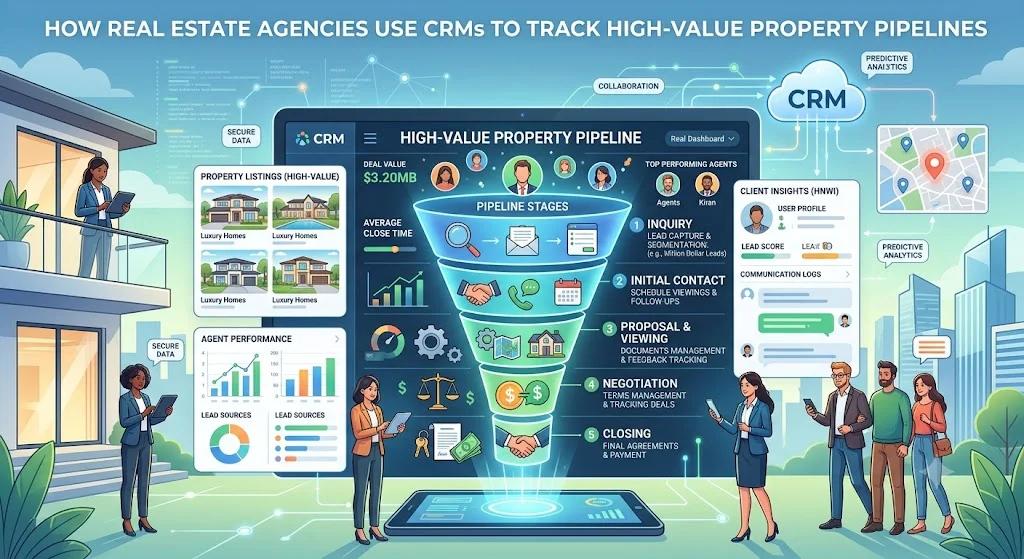
In the high-stakes real estate market, managing a sales pipeline is fundamentally different from traditional retail or standard B2B software sales. Property transactions involve prolonged negotiation lifecycles, massive capital allocations, multi-tiered legal compliance documentation, and deeply personal emotional investments from buyers. For modern real estate brokerages and property agencies, relying on decentralized spreadsheets or generic administrative tracking tools to manage these complex variables is a recipe for operational failure.
To maintain a competitive edge, elite real estate agencies utilize specialized Customer Relationship Management (CRM) systems. By transforming passive databases into active, property-centric tracking ecosystems, these platforms allow brokers to orchestrate high-value deals with total mathematical precision.
Mapping the Property-Client Matrix: Dual-Core Architecture
A standard transactional CRM treats a lead as a single entity moving linearly down a funnel. Real estate operations, however, require a dual-core data architecture. Agents must simultaneously track two distinct, interlinked entities: The Inventory (Properties) and The Demand (Clients).
Advanced real estate CRMs resolve this by implementing automated matching algorithms within their database schemas:
-
Inbound Property Ingestion: When a new luxury villa or commercial building is listed, the agent logs structural metadata—such as geographic coordinates, square footage, zoning restrictions, tax parameters, and specific architectural amenities.
-
Automated Demand Matching: The CRM automatically scans the active buyer database, instantly filtering profiles whose budget brackets, location preferences, and investment timelines align with the newly ingested listing.
This immediate cross-referencing eliminates hours of manual database sorting, allowing brokers to pitch high-value assets to qualified investors within minutes of the listing going live.
Automating the Compliance and Legal Document Lifecycle
The path to closing a real estate transaction is paved with strict legal guardrails. Missing a single escrow deadline, failing to verify a buyer’s proof of funds, or misplacing an environmental disclosure form can permanently collapse a multi-million dollar transaction and expose the agency to severe regulatory liabilities.
Modern CRM architectures mitigate these risks by embedding automated workflow checklists directly into the transaction pipeline stage triggers:
Plaintext
Deal Moves to "Under Contract" --> CRM Locks Pipeline Stage --> Triggers Mandatory Document Uploads (Title Search, Escrow Proof) --> Auto-Alerts Legal Compliance Team
Until the mandatory PDF documents are uploaded and verified via cryptographic digital signatures, the system prevents the agent from advancing the deal. This enforces absolute structural compliance across the entire brokerage without slowing down operational velocity.
Long-Term Relationship Nurturing and Lifetime Value Optimization
For premium real estate agencies, a closed transaction is not the end of a customer relationship; it is the beginning of a multi-year nurture cycle. Real estate investors and residential buyers frequently upgrade portfolios, purchase secondary vacation homes, or liquidate assets over a ten-to-fifteen-year lifecycle. Furthermore, satisfied clients represent a primary source of organic, high-value referral traffic.
Real estate CRMs capitalize on this by executing long-term, low-frequency automated communication tracks driven by historical purchase data:
Post-Sale Milestone Triggers
The system schedules automated interaction checkpoints on specific dates—such as the exact anniversary of the property closing or the end of a corporate tax fiscal year—delivering personalized market valuation updates directly to the property owner.
Hyper-Localized Market Alerts
If a major commercial development project or zoning change occurs near a property previously sold by the agency, the CRM automatically flags the historical buyer. This proactive outreach positions the broker as a data-driven advisor, frequently triggering secondary listings or portfolio expansion inquiries.
Conclusion: The Backbone of Modern Property Brokerage
In an industry where timing, relationship depth, and administrative accuracy dictate market dominance, a specialized CRM is the ultimate operational leverage. By unifying property inventory with real-time client demand, automating high-risk compliance lifecycles, and programmatically securing long-term client loyalty, these cloud-native platforms empower real estate agencies to scale their operations smoothly, insulate themselves from legal friction, and maximize the closing volume of high-value property portfolios.

