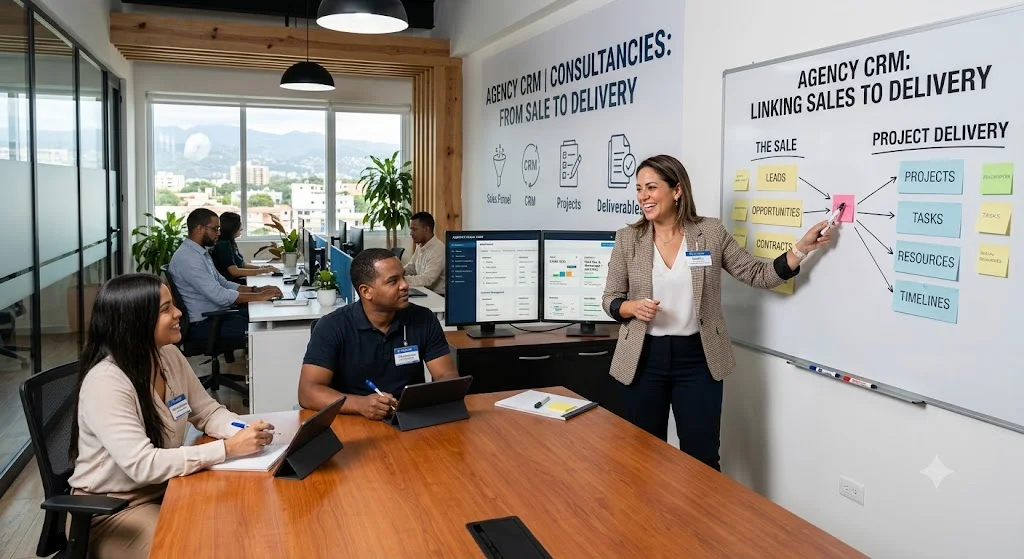
For professional service firms—like digital marketing agencies, software houses, and management consultancies—the biggest operational bottleneck is not closing the deal. It is what happens the day after the deal is closed.
In many agencies, the sales team lives in a CRM, while the delivery team lives in a project management tool. This structural division leads to “the handoff gap.” Requirements get lost in translation, project managers are blind to what was promised, and resource planning becomes reactive fire-fighting.
Linking your CRM directly to project delivery closes this gap, ensuring that what is promised during the sales cycle is executed seamlessly.
The Handoff Gap: Why Isolated CRMs Fail Agencies
When sales and delivery teams operate in silos, agencies suffer from three profit-killing issues:
-
Scope Creep: Sales representatives sell custom features or extra revisions to close a deal without checking if the production team has the bandwidth or budget.
-
Delayed Kickoffs: After the contract is signed, days or weeks are lost manually recreating client files, setting up shared Slack channels, and assigning tasks.
-
Under-allocation of Resources: Without visibility into the active sales pipeline, resource managers cannot predict hiring needs or project starting dates.
How an Integrated CRM-to-Delivery System Solves the Gap
A unified system—often referred to as a Professional Services Automation (PSA) tool or an agency-tailored CRM—integrates contact management with task execution.

When sales pipelines are linked directly to delivery workflows, your business changes in three key ways:
1. Automatic Project Provisioning
The moment a deal stage transitions to “Closed-Won” in your CRM, automation triggers the creation of the project environment. Using predefined templates based on the purchased package (such as a SEO onboarding package or a custom web build), the system instantly:
-
Generates a new project board with standardized tasks and milestones.
-
Populates folder directories with sales-stage discovery notes and brief documents.
-
Sends an automated welcome email with a scheduler link for the client kickoff call.
2. Live Pipeline-to-Capacity Forecasting
By monitoring the progress of deals in the pipeline, resource planners gain a forward-looking window into upcoming demand.
If three separate $50,000 software development contracts are in the “Proposal Sent” phase with a high probability of closing, the engineering leads can actively reserve developer availability or source trusted contractors before the ink is dry.
3. Integrated Financial Tracking
True agency profitability depends on tracking estimated hours against actual hours worked. Connecting your CRM to time-tracking and project boards allows you to immediately see if a client account is remaining profitable. If your delivery team is spending twice as many hours as estimated, the account management team can adjust pricing or renegotiate terms on the next contract cycle.
Comparing Leading CRM and Project Delivery Approaches
Different agencies require different setups depending on their size and structural complexity:
| Strategy | Best Suited For | Key Advantages | Downsides |
| All-in-One PSA Software (e.g., Productive, Scoro, Mavenlink) | Mid-sized to large agencies looking for a single source of truth. | Complete data continuity; native time tracking, invoicing, and CRM in one dashboard. | Higher learning curve; less customization in the sales pipeline compared to dedicated CRMs. |
| Dedicated Integration (e.g., Salesforce + Jira, or HubSpot + Asana) | Enterprise agencies with highly specialized, distinct departments. | Allows both sales and development teams to use the absolute best tools for their specific tasks. | Requires continuous maintenance of API connections and integration middleware. |
| Modular Task Platforms (e.g., ClickUp, Monday.com) | Small agencies and boutique consultancies. | Low cost; highly visual and flexible enough to build custom CRM pipelines and task lists in one place. | Lacks deep, native financial modeling and advanced resource utilization metrics. |
Conclusion: Turning Handoffs into Competitive Advantages
The smoothest way to stand out in a crowded agency market is to deliver an exceptional onboarding experience. When your delivery team shows up to the kickoff call fully briefed—knowing exactly what the client wants without making them repeat themselves—you establish trust from day one.
By linking your sales pipeline to project delivery, you eliminate administrative friction, protect your profit margins, and set up your client relationships for long-term retention.

