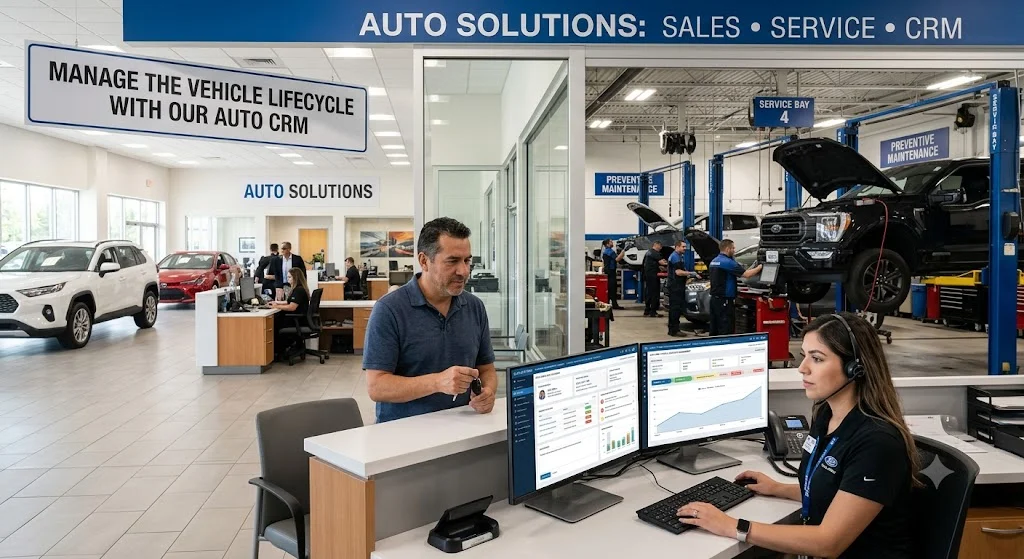
The automotive sector is facing a more digital, demanding, and impatient customer than ever before. It is no longer enough to just sell a car or complete a repair on time. The true financial success of a modern dealership or repair shop lies in long-term customer loyalty.
This is where a specialized CRM (Customer Relationship Management) system comes into play—a tool designed not only to manage contacts but to intelligently track and optimize the entire vehicle lifecycle.
Here is how a dedicated automotive CRM transforms every stage of this cycle into recurring revenue.
What Is the Vehicle Lifecycle in a CRM Context?
The vehicle lifecycle encompasses every single interaction a car has with your business. It starts when the car is a new unit in the dealership’s inventory, moves through years of preventative and corrective maintenance in the workshop, and goes all the way to the moment the owner decides to trade it in for a newer model.
The Golden Rule of the Automotive Industry: A car leaving the showroom is not a closed transaction; it is the beginning of a post-sales service chain that can easily double the customer’s initial lifetime value if managed through automation.
The 4 Key Stages of the Vehicle Lifecycle and How CRM Manages Them
An automotive-specific CRM allows businesses to automate and optimize each critical phase of a vehicle’s journey:
1. Acquisition and Sales (The Start of the Cycle)
In this phase, the CRM acts as your primary lead acquisition engine, centralizing prospects from your website, social media, and third-party marketplaces.
-
Automated Follow-ups: Automatically send personalized quotes and schedule test drives.
-
Vehicle Profiling: Once the sale is finalized, the system automatically registers the VIN, registration date, initial technical specs, and warranty details.
2. Active Post-Sales (Maintenance & Repairs)
This is the longest and most profitable stage of the cycle. Connecting your CRM to your workshop’s ERP enables proactive management rather than reactive service.
-
Predictive Alerts: Based on the customer’s average annual mileage, the system calculates and predicts when they will need their next oil change, brake service, or annual inspection.
-
Automated Campaigns: Send targeted SMS or email reminders: “Hi John, your vehicle is approaching its 10,000-mile service. Book your appointment today and get 10% off.”
3. Diagnostics and Vehicle Health History
Every time a car enters your service bay, the CRM compiles highly valuable data.
-
Total Traceability: Track exactly what parts were replaced, past diagnostic trouble codes (DTCs) from OBD-II scanners, and repairs made to sensitive internal electronics like ECUs or comfort modules.
-
Customer Transparency: Share digital vehicle health reports with customers before starting repairs, boosting trust and increasing your average ticket size.
4. Retention and Renewal (Closing the Loop)
When a vehicle reaches a certain age or mileage threshold, the CRM automatically triggers renewal alerts.
-
Trade-In Opportunities: The system flags customers driving 4-to-5-year-old vehicles, prompting sales reps to offer a trade-in valuation toward a newer model.
-
The Second Lifecycle: The traded-in vehicle enters your pre-owned inventory, restarting the entire lifecycle with a new owner.
Key Benefits of Implementing an Automotive CRM
If you are still managing service appointments on paper or generic spreadsheets, you are leaving money on the table. A specialized CRM delivers immediate returns:
| Benefit | Business Impact |
| Higher Service Retention | Boost repeat workshop visits by up to 30% through automated, timely maintenance reminders. |
| Inventory Optimization | Anticipate which spare parts and consumables will be needed based on scheduled appointments. |
| Improved CSAT (Customer Satisfaction) | Automatically send feedback surveys post-service to quickly resolve any customer complaints. |
| Team Productivity | Service advisors and technicians can access a vehicle’s complete history in a single click, reducing wait times. |
Conclusion: Software as a Profit Engine
The vehicle of the future is hyper-connected, and the businesses that support it must be too. An automotive CRM is not just an administrative expense—it is the digital infrastructure required to ensure that every vehicle you sell or repair returns to your bays time and time again.
Optimizing the vehicle lifecycle is the smartest way to maximize Customer Lifetime Value (CLV) and secure the long-term profitability of your automotive business.

