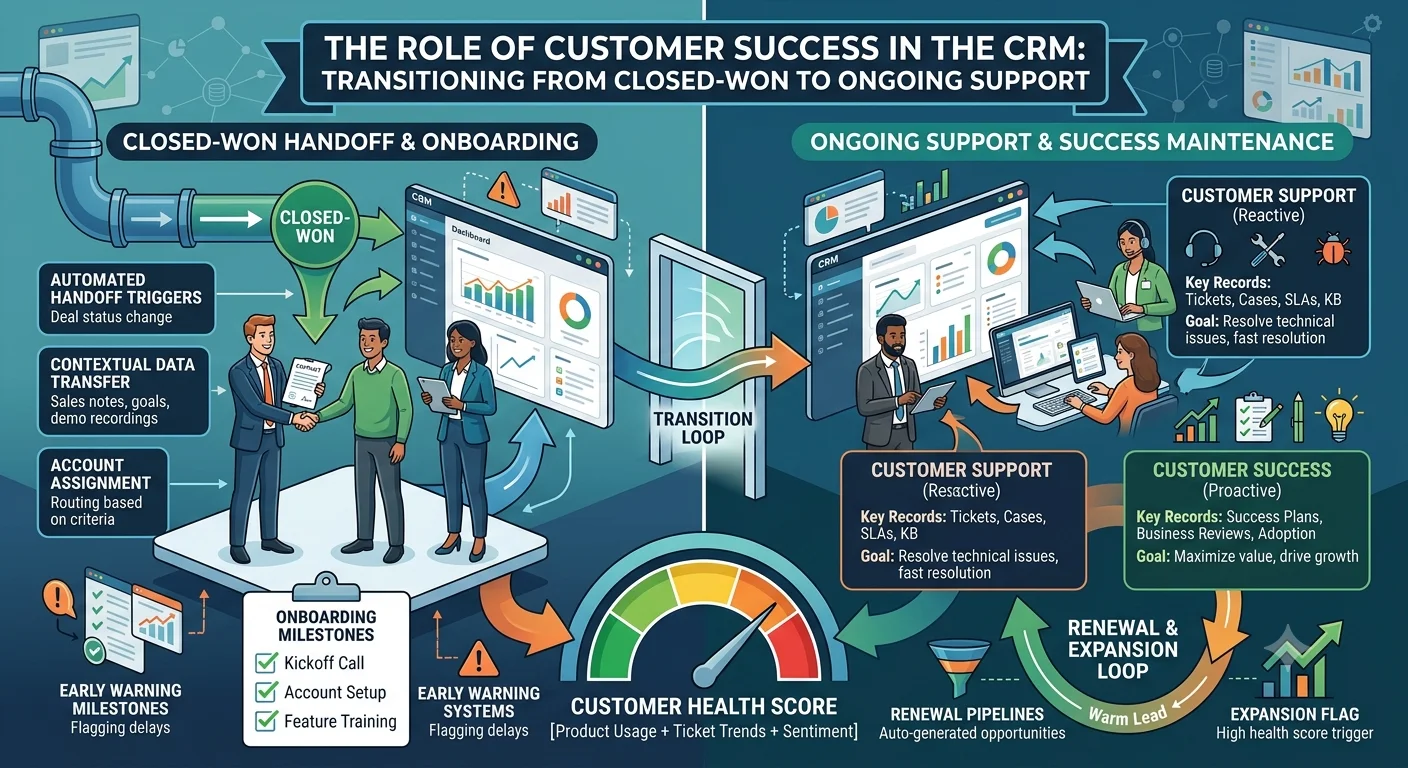
For many businesses, the “Closed-Won” status in the CRM marks the finish line of the sales process. But in reality, it is merely the starting line for the Customer Success journey.
If your CRM only tracks the sale, you are missing the most profitable part of your business: the recurring relationship. Transitioning from “Closed-Won” to “Ongoing Support” requires shifting your CRM from a sales pipeline tool to a relationship management ecosystem.
The Handoff: Why the “Closed-Won” Gap Happens
In many organizations, the sales team moves on to the next deal, and the customer is left in limbo waiting for onboarding. This “handoff gap” is where trust is lost.
To bridge this, your CRM must be configured to treat the “Closed-Won” status as a trigger for internal orchestration, not a signal to stop tracking the account.
3 Strategies to Operationalize Customer Success
1. Automated Onboarding Sequences
The moment a deal moves to “Closed-Won,” the CRM should trigger a dedicated onboarding workflow. This ensures consistency for every new client.
-
The Welcome Hub: The system automatically generates a personalized “Client Portal” link, sends a welcome email with a scheduler for the kickoff call, and provides a customized checklist of what the client needs to provide.
-
Team Alerting: The CRM notifies the assigned Customer Success Manager (CSM) and includes a summary of all notes, pain points, and specific goals discussed during the sales process, so the client never has to repeat themselves.
2. Monitoring the “Value Realization” Phase
The biggest reason for early-stage churn is that the client bought your product but never achieved their first “win.”
-
Key Milestone Tracking: In your CRM, create custom fields for “Time to First Value” (e.g., date of first successful campaign, date of first integration, or date of first training session).
-
Automated Intervention: If a client hasn’t reached their first milestone within a set timeframe (e.g., 30 days post-sale), the CRM should trigger an automated “Red Alert” task for the CSM to intervene.
3. Periodic Health Check Automations
Don’t wait for a client to complain before reaching out. Use the CRM to standardize your proactive engagement.
-
Automated Quarterly Business Reviews (QBRs): The system triggers a reminder to the CSM 30 days before a client’s 90-day anniversary, ensuring a meeting is scheduled to review progress, showcase ROI, and discuss future expansion.
-
Sentiment Tracking: Log every interaction (calls, emails, ticket status) as a “Health Score” in the CRM. If the health score drops, the CRM flags the account as “At-Risk,” allowing you to save the client before they look for alternatives.
Mapping the Post-Sale Lifecycle
| Stage | Goal | CRM Action |
| Onboarding | Smooth transition to delivery | Automated welcome and task assignment. |
| Adoption | Ensuring the user gets value | Tracking milestone completion dates. |
| Retention | Demonstrating ongoing ROI | Automated QBR reminders and check-ins. |
| Expansion | Finding cross-sell opportunities | Tracking usage growth and satisfaction. |
The Success Metric: The most successful CSM teams don’t just track if a client is “happy”—they track if the client is achieving the outcomes they bought your product to solve.
Conclusion: Making the Relationship Sustainable
Transitioning your CRM to support Customer Success is the only way to scale your business sustainably. When your entire team—from the salesperson who closed the deal to the CSM who manages the renewal—has a unified view of the client’s progress, the transition from sale to support becomes invisible.
By automating the administrative heavy lifting of onboarding and tracking milestones, your team can focus on what really matters: helping your customers win. When your customers succeed, your company doesn’t just retain them—you turn them into loyal advocates who drive your future growth.

