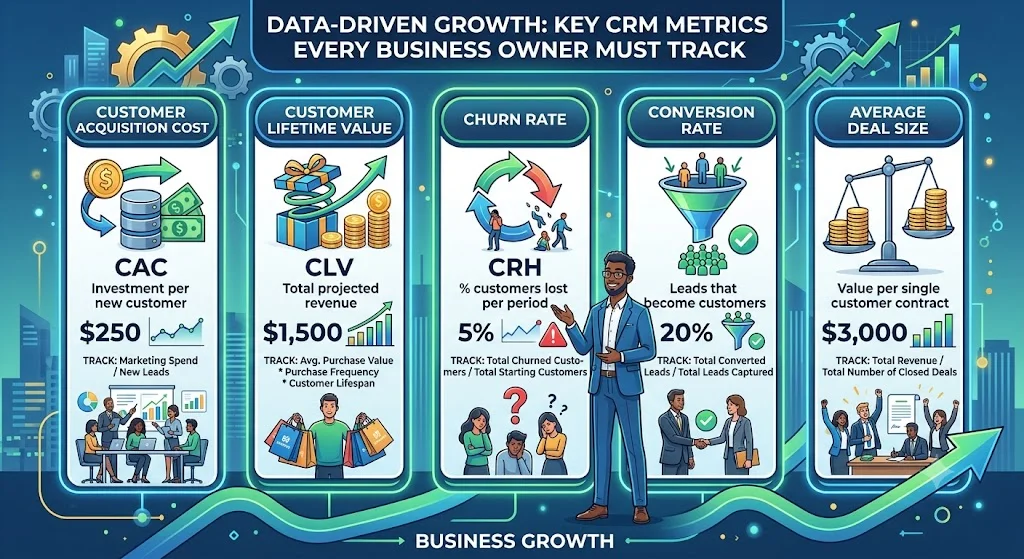
In the contemporary enterprise landscape, scale is impossible without visibility. Operating a sales or service pipeline without granular performance analytics is equivalent to piloting an aircraft without flight instruments. While modern Customer Relationship Management (CRM) platforms capture millions of individual data points every day, many organizations fall into the trap of tracking superficial vanity metrics—such as total emails sent or raw lead volume ingestion—rather than focusing on figures that indicate true financial health.
To build a highly predictable, scalable sales engine, business owners must isolate the core metrics that directly influence cash flow, operational efficiency, and long-term customer equity. This guide outlines the essential CRM infrastructure metrics required to drive data-backed strategic decisions.
1. Customer Acquisition Cost (CAC) Efficiency
Customer Acquisition Cost represents the total financial allocation required to secure a single new customer. Calculating this metric accurately requires pulling data from both marketing expenses and CRM sales pipelines.
The Analytical Formula
A cloud CRM allows business owners to break down CAC by specific lead sources or marketing channels. If your dashboard reveals that leads ingested via traffic arbitrage or paid search carry a CAC that exceeds their immediate transactional value, it signals a critical need to reallocate budget toward organic, high-converting pipelines.
2. Customer Lifetime Value to CAC Ratio (LTV:CAC)
Tracking CAC in isolation provides an incomplete picture. To understand long-term corporate viability, it must be cross-referenced with Customer Lifetime Value (LTV)—the total gross revenue an individual account or client profile generates throughout their entire relationship with your organization.
-
The Health Benchmark: In healthy, scaling business architectures, the ideal LTV to CAC ratio is 3:1 or higher. This means a customer should generate at least three times more revenue than it cost to acquire them.
-
Diagnosing an Imbalance: A ratio of 1:1 indicates that your sales mechanism is burning capital simply to break even. Conversely, an excessively high ratio (e.g., 5:1) often indicates that the organization is underinvesting in marketing and missing clean opportunities for aggressive market expansion.
3. Pipeline Velocity (The Sales Momentum Index)
Pipeline Velocity measures the speed at which a lead navigates through your entire structural sales funnel—from the initial API ingestion checkpoint to the finalized “Closed-Won” database status.
The Velocity Equation
Where:
-
$A$ = Number of active qualified leads in the pipeline.
-
$W$ = Average win rate percentage (conversion efficiency).
-
$L$ = Average deal value (in currency units).
-
$T$ = Average sales cycle length (in days).
Increasing your pipeline velocity does not necessarily require spending more money on lead generation. By implementing automated follow-up sequences or utilizing predictive lead scoring to eliminate stale accounts, you can drastically reduce $T$ (time), which accelerates cash flow velocity and maximizes sales team capacity.
4. Pipeline Stage Conversion Rates (Funnel Friction Analysis)
A healthy CRM pipeline dashboard must show exactly where prospects drop out of the sales sequence. Business owners should track the historical transition percentages between every single pipeline stage:
Plaintext
Lead Ingested --> [80% Convert] --> Demo Scheduled --> [40% Convert] --> Proposal Sent --> [25% Convert] --> Closed-Won
If the data shows a massive statistical drop-off at a specific juncture—for instance, moving from “Demo Scheduled” to “Proposal Sent”—it isolates a specific operational bottleneck. This metric tells you exactly where your sales training or technical documentation requires optimization to prevent pipeline leakage.
Strategic Conclusion: The Transition to Predictive Management
Relying on gut feeling to steer a company introduces unnecessary risk into an organization. By hardcoding these key metrics into your CRM central dashboards, you transform your sales software from a passive digital address book into a highly sophisticated intelligence asset.
Monitoring CAC efficiency, LTV balances, pipeline velocity, and stage conversion friction allows business owners to identify operational weaknesses early, forecast future revenue trends with absolute mathematical precision, and deploy corporate capital only where it delivers the highest possible return on investment.

