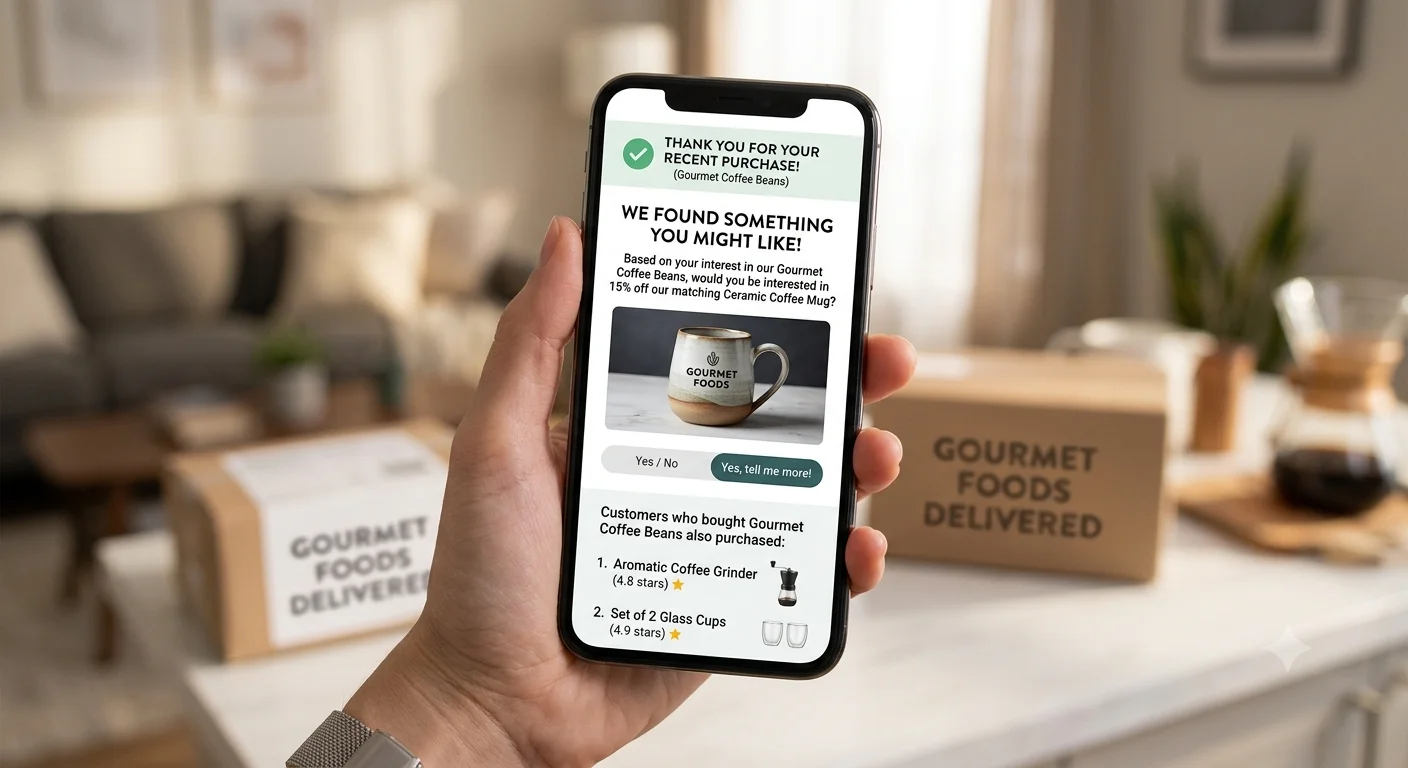
To grow revenue without increasing your marketing spend, the most effective strategy is to sell more to the people who already trust you.
Generic “mass email” campaigns for cross-selling often feel like spam. However, CRM-driven, behavior-based cross-selling feels like personalized advice. By using your CRM to analyze what a customer has already purchased, you can automate offers that are logically timed and hyper-relevant.
The Cross-Sell Logic: Predictive Sequences
Your CRM should not just store data; it should actively look for “Next Best Offer” opportunities. When a client finishes a project or buys a product, their historical data holds the key to their next need.
To build an automated cross-sell engine, you need to categorize your products into logical “Purchase Paths”:
-
Complementary Goods: Items that naturally go together (e.g., selling a printer to someone who bought a laptop).
-
Service Tiers: Upgrading from a basic entry-level package to a premium or enterprise service level.
-
Consumables & Replenishment: Selling items that expire or wear out based on the date of the last purchase.
3 Automated Cross-Sell Workflows
Don’t wait for your sales team to manually suggest products. Automate the “Next Best Offer” using these three CRM-powered workflows:
1. The “Usage-Based” Replenishment Alert
If you sell products that require regular maintenance or replacement, set a CRM field to track the “Average Life Span” of that item.
-
Trigger: Last purchase date + [Average lifespan of product] minus 30 days.
-
Action: The CRM triggers an automated email: “Hi [Name], your [Product] is approaching its usual replacement interval. We want to ensure you don’t face any downtime—click here to reorder with a 5% loyalty discount.”
2. The “Package Completion” Sequence
If your services are modular, track which modules a customer has already bought.
-
Trigger: Contact is tagged with “Purchased: Module A.”
-
Action: 14 days after the successful delivery of Module A, the CRM sends a case study showing how a client achieved [X result] by combining Module A with Module B. The email includes a “One-Click Add-on” link for Module B.
3. The “Account Growth” Expansion
For B2B consultancies, use CRM data to monitor headcount or business scale.
-
Trigger: A change in the “Company Size” field in the CRM or a request for additional user seats/licenses.
-
Action: The system flags the account as “Growth Ready” and notifies the Account Manager to reach out with a personalized presentation on your higher-tier service package.
The “Perfect Timing” Matrix
Automation fails when the timing is wrong. Use this matrix to ensure your cross-sell campaigns land at the right moment:
| Client State | Cross-Sell Strategy | Best Automation Trigger |
| New Customer | Onboarding Cross-Sell | 48 hours post-first-purchase. |
| Consistent Buyer | Replenishment / Upsell | Based on usage date fields. |
| Loyal/Long-term | Premium Tier Upgrade | Annual review or milestone dates. |
| Lapsed Buyer | “Win-back” Cross-Sell | Last activity date + 90 days. |
The Relevance Rule: The more specific your data, the higher your conversion rate. A cross-sell offer is only “helpful” if it actually solves a problem the customer has right now.
4 Keys to High-Converting Cross-Sell Emails
-
The “Helper” Tone: Frame the offer as a way to improve their current setup, not just an attempt to get more money.
-
Dynamic Personalization: Use CRM tags to include their specific industry or the name of the product they bought previously. “Since you already use our [Software A], adding [Software B] will allow you to do [Specific Benefit].”
-
Low-Friction CTA: The offer should be a “one-click” experience. The fewer hoops the customer has to jump through, the higher your conversion.
-
A/B Test Your Triggers: Some customers respond better to replenishment emails, while others prefer upgrade offers. Test the timing in your CRM to see which workflow yields the highest revenue per client.
Conclusion: Maximizing Customer Lifetime Value
Automated cross-selling turns your CRM into a revenue-generating machine that works while you sleep. By analyzing purchase history and setting up automated replenishment or expansion sequences, you transition from a vendor to a strategic partner.
When your offers are timed perfectly with the customer’s lifecycle, you aren’t just selling more—you are providing more value, reducing customer churn, and significantly increasing the Customer Lifetime Value (CLV) of every contact in your database.

