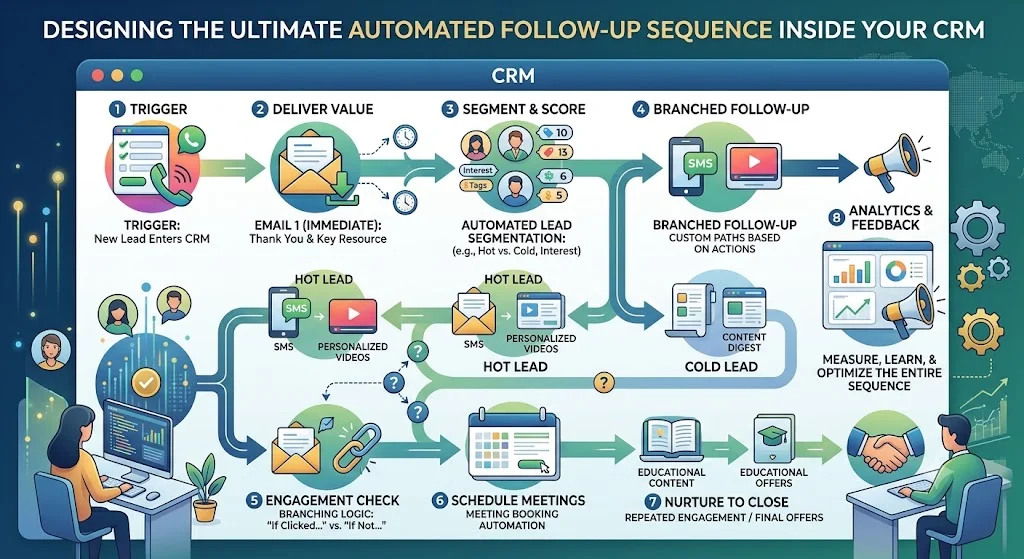
In the digital sales ecosystem, the fortune is in the follow-up. However, relying on manual execution by sales representatives introduces severe operational friction, leads to delayed response times, and results in valuable pipeline leakage. While building automated email sequences inside a Customer Relationship Management (CRM) infrastructure is essential to scale, poorly designed automation can alienate prospects and damage domain sender reputation.
Designing a high-conversion automated sequence requires balancing precision timing, data-driven personalization, and strict logic rules. This blueprint outlines how to build an enterprise-grade automation framework directly within your CRM database architecture.
Phase 1: The Instant Ingestion Trigger
The absolute foundation of an effective follow-up sequence is immediate response velocity. When a prospect submits a high-intent web form, the conversion probability drops drastically with every hour of administrative delay.
The initial step must execute programmatically at the database level. As soon as the CRM API creates a new lead object matching specific conditions, the system must immediately trigger the first interaction.
CRM Webhook Trigger:
[New Lead Created]
   └── Criteria: Lead_Source == "Enterprise Demo Form"
   └── Criteria: Lead_Status == "Unassigned"
   └── Action: Execute Immediate Webhook webhook.email_service()
This instant response confirms to the prospect that their request has successfully entered the system, while capturing their undivided attention before they navigate to a competitor’s site.
Phase 2: Building Behavioral Time Delays
The most common mistake in CRM automation is blasting emails back-to-back without strategic spacing. Flooding a prospect’s inbox signals robotic automation and increases the risk of the user marking the messages as spam.
Instead, implement structured conditional time delays based on professional communication patterns:
-
Day 1 (The Immediate Hook): Send a personalized email within 5 minutes of form submission, providing direct links to schedule a call via calendar integrations.
-
Day 3 (The Contextual Value Drop): Wait exactly 48 hours. If the lead has not booked a meeting, automatically trigger a secondary message introducing a case study highly relevant to the prospect’s industry sector.
-
Day 7 (The Operational Pain-Point Callout): Wait 96 additional hours. Deliver a concise email addressing specific infrastructure challenges and offering a brief, direct question to prompt a manual reply.
Phase 3: Implementing Multi-Branch Conditional Logic
A linear automated sequence that continues sending pre-written emails regardless of user behavior is highly inefficient. Modern CRM workflows must utilize multi-branch conditional logic to dynamically adapt the communication track based on real-time prospect engagement.
The system should evaluate user interaction checkpoints before executing subsequent steps:
                     [Check: Has Meeting Been Booked?]
                                /        \
                             (Yes)      (No)
                              /            \
[Exit Sequence & Move to Active Sales]    [Check: Did they Open Email 2?]
                                              /             \
                                           (Yes)           (No)
                                            /                 \
                     [Trigger Deeper Tech Resource]    [Send Alternative Subject Line]
By branching the paths, you ensure that a prospect who is actively reading your technical documentation receives completely different messaging than a lead who has not opened a single email.
Phase 4: Enforcing Absolute Exit Criteria
Continuing to send automated marketing sequences after a prospect has picked up the phone or replied to an email is a catastrophic user experience failure. It immediately shatters the illusion of personalized human communication and exposes system disorganization.
Every automated sequence must be governed by ironclad Exit Criteria at the CRM workflow layer. Configure the automation engine to instantly terminate the sequence if any of the following system events are logged:
-
Lead Status Change: The contact record transitions from “New/Unassigned” to “Working/Contacted”.
-
Activity Ingestion: The CRM database registers an inbound email reply or a completed manual phone call log by a representative.
-
Task Creation: A sales agent manually schedules an upcoming custom demonstration, overriding the automated background tracks.
Strategic Conclusion: The Power of Optimized Automation
An optimized CRM follow-up sequence is not about sending more emails; it is about sending the right message at the absolute mathematical moment of highest impact. By structuring your pipeline with instant API triggers, behavioral branch logic, and foolproof exit parameters, you protect your sales team’s operational time.
This programmatic approach ensures that no viable lead is ever abandoned, driving systematic conversion rates upward while maintaining a polished, premium corporate identity.

