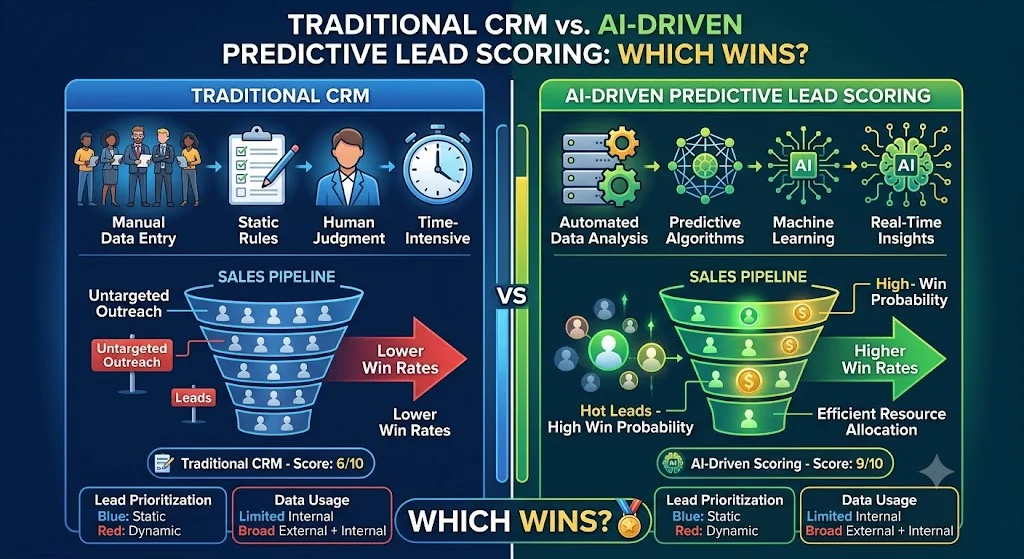
The core objective of any enterprise sales pipeline is optimization—allocating high-value human capital to the prospects most likely to convert. For decades, traditional Customer Relationship Management (CRM) systems relied on manual categorization and static numeric rules to evaluate lead quality. While this framework brought basic order to sales databases, it introduced significant human bias and fell short when dealing with large, fast-moving traffic.
The integration of artificial intelligence into cloud database architectures has introduced a fundamental shift: predictive lead scoring. By deploying machine learning models to analyze deep operational data in real time, organizations are moving away from reactive tracking and embracing proactive, data-driven conversion strategies.
The Static Framework of Traditional Lead Scoring
Traditional lead scoring models operate on rigid, administrator-defined parameters. An IT or sales manager establishes a point system based on explicit demographics or basic behavioral checkpoints. For example, a lead might receive twenty points if their corporate title contains “Director” and another ten points if they download a specific whitepaper.
While straightforward to deploy, this static methodology suffers from several structural vulnerabilities:
-
Susceptibility to Human Bias: The weights assigned to specific actions or attributes are fundamentally based on internal assumptions rather than empirical, mathematical proof. Sales teams frequently overvalue certain marketing interactions while completely ignoring subtle, underlying behavioral patterns.
-
Inability to Adapt to Market Changes: Static rules do not automatically adjust to shifts in consumer behavior or macroeconomic trends. If a specific industry sector experiences a sudden downturn, a traditional CRM will continue grading leads from that sector using outdated, high-value metrics until an administrator manually reconfigures the underlying rules.
-
Data Fragmentation Overhead: Manual scoring systems rarely account for time decay. A prospect who visited a pricing page five times in a single afternoon three months ago might carry the same elevated score as a prospect who performed those actions twenty minutes ago, resulting in misallocated sales efforts.
How AI-Driven Predictive Models Process the Pipeline
Predictive lead scoring replaces manual rule sets with algorithmic data analysis. Instead of waiting for a manager to guess which criteria matter most, machine learning models scan historical CRM data to identify the exact behavioral and demographic footprints of accounts that successfully converted in the past.
When a new lead enters the database infrastructure, the predictive model runs a multi-dimensional analysis, evaluating hundreds of data points concurrently:
Deep Behavioral Analysis
The algorithm looks far beyond basic email clicks. It evaluates the exact velocity of user interactions, content consumption sequences, time spent on specific documentation pages, and natural language sentiment extracted from inbound chat logs or support tickets.
Enrichment via External Data Streams
Advanced predictive engines automatically cross-reference inbound corporate domain names with external business registries. The system instantly appends critical infrastructure details—such as the target company’s estimated annual revenue, technical stack components, and recent hiring trends—without requiring manual input from front-end forms.
Continuous Algorithmic Calibrations
Unlike static configurations, predictive scoring models adapt automatically. As sales reps log closed-won or closed-lost outcomes in real time, the underlying algorithm refines its predictive coefficients, constantly improving its accuracy based on fresh database feedback.
Operational Comparison: Aligning Sales Focus
The choice between traditional and AI-driven systems directly impacts how an enterprise utilizes its daily operational resources. Relying on outdated manual sorting structures often results in sales representatives chasing cold leads, which drives up customer acquisition costs and lowers morale.
In contrast, predictive lead scoring optimizes resource distribution by dividing incoming traffic into high-confidence conversion brackets. Representatives are automatically alerted to focus on accounts displaying immediate buying velocity, while middle-tier prospects are seamlessly routed to automated, long-term nurturing workflows inside the cloud infrastructure.
Strategic Conclusion: The Architectural Verdict
Traditional lead scoring frameworks remain useful for early-stage startups or businesses handling exceptionally low lead volumes where human intuition can still manage the pipeline. However, for scaling enterprises navigating complex B2B sales cycles or managing high-volume digital traffic, manual rule systems represent a severe bottleneck.
Implementing predictive lead scoring transitions the CRM from a passive storage database into an active, intelligent piece of operational infrastructure. By leveraging machine learning to automate lead prioritization, organizations eliminate administrative guesswork, protect their data pipelines from human error, and establish an agile sales foundation capable of maximizing conversion rates in highly competitive markets.

