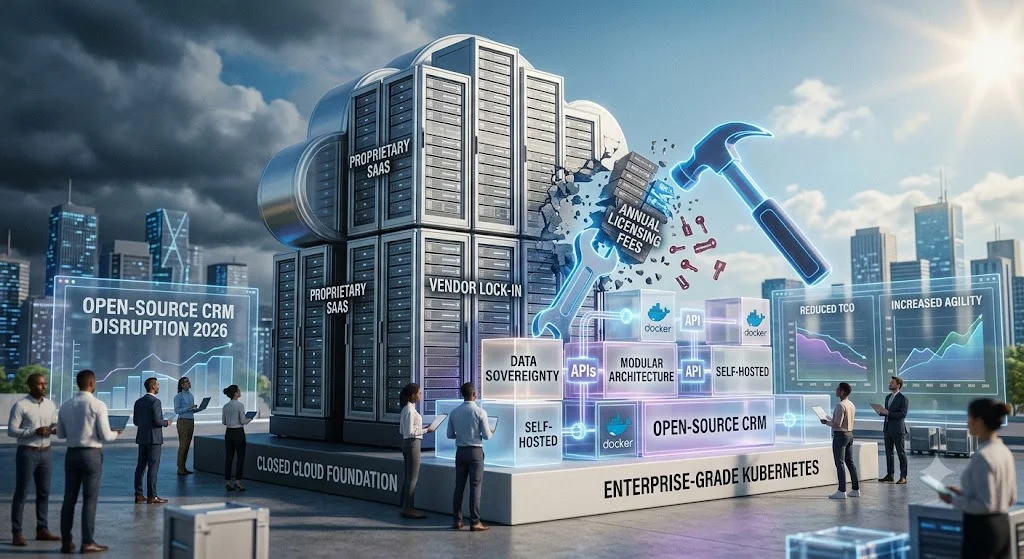
For over a decade, the enterprise Customer Relationship Management (CRM) landscape followed a predictable, centralized trajectory. Legacy SaaS monoliths established complete dominance by coupling software licenses with cloud hosting infrastructure. This framework forced enterprise IT departments into a structural trade-off: accepting compounding operational expenses and restrictive vendor lock-ins in exchange for rapid deployment speeds.
However, the macroeconomic conditions and technological shifts of 2026 have disrupted this dynamic. The combination of hyper-optimized local hardware architectures, mature containerized deployment ecosystems, and stringent data sovereignty mandates has transformed how organizations view utility software. Open-source CRMs are no longer experimental codebases restricted to small-scale businesses; they are actively rewriting the rules of modern enterprise tech infrastructure.
The Architectural Shift: De-Coupling the Data Layer from the Vendor
The core infrastructure flaw of proprietary SaaS platforms lies in the absolute coupling of the application logic and the underlying database layer. When an enterprise stores critical client interactions inside a closed cloud ecosystem, the organization loses direct execution privileges over its raw data structural design. Extracting or manipulating this data at scale requires proprietary APIs, which are frequently metered, performance-throttled, or limited by subscription tiers.
Modern open-source frameworks like SuiteCRM 8, Odoo Enterprise, and headless solutions such as Corteza decouple these layers completely. By utilizing native database engines like PostgreSQL or MariaDB running inside isolated, localized environments, enterprise infrastructure architects regain full sovereignty over their schemas.
Technical Architectural Reality:
Total Cost of Ownership (TCO) Analysis: The 2026 Infrastructure Calculation
Enterprise procurement departments are heavily scrutinizing seat-based SaaS pricing models. As organizations scale horizontally, adding thousands of internal operations users, field technicians, and customer success agents under a seat-based license produces a linear cost expansion that outpaces infrastructural value.
The shift toward open-source options restructures this financial equation from a variable licensing expense into a fixed, highly predictable infrastructure asset. The comparative breakdown below outlines the structural shift in resource allocation over a standard 36-month enterprise lifecycle:
| Infrastructural Dimension | Proprietary SaaS Framework | Enterprise Open-Source Framework |
| Licensing Structure | Per-user, per-month dynamic licensing. Scale correlates with increased monthly expenditure. | Zero licensing overhead. Capital is redirected strictly to system infrastructure and maintenance teams. |
| Data Storage Scaling | Tiered pricing models. High premiums applied for database storage tier expansions. | Direct commodity storage costs (e.g., AWS S3, local NVMe arrays, self-managed SAN). |
| Compute Optimization | Shared, multi-tenant cloud structures. Resource allocation is dictated by the vendor. | Dedicated hardware scaling. Compute resources dynamically adapt via internal orchestration. |
| API & Integration Overhead | Metered rate limits. Premium tiers required for advanced enterprise synchronization. | Unrestricted internal loop microservices. Bare-metal integration speeds at zero marginal cost. |
While open-source architectures demand higher upfront internal engineering capital for initial deployment, configuration, and continuous integration (CI/CD) setup, the inflection point typically occurs between months 14 and 18. Past this threshold, the savings accumulated by eliminating license fees fundamentally offset the operational costs of internal infrastructure management teams.
Data Sovereignty and Compliance in a Fragmented Regulatory Era
Regulatory frameworks have advanced beyond the baseline requirements established by GDPR and CCPA. Modern compliance mandates now demand granular control over precisely where data resides, how it is processed across international boundaries, and who maintains cryptographic access keys.
Proprietary cloud platforms process information across distributed server networks. While they offer region-specific data residency options, the data layer still passes through third-party management systems, exposing corporations to subtle regulatory liabilities and compliance gaps.
Open-source platforms eliminate this risk through absolute deployment flexibility. An enterprise can isolate its entire CRM environment inside a strict, zero-trust hybrid cloud configuration:
-
On-Premises Bare Metal: Restricting classified defense, financial, or healthcare data to physical servers completely isolated from the public internet.
-
Private Cloud Orchestration: Deploying inside dedicated Virtual Private Clouds (VPCs) across secure, local enterprise clouds where data never shares physical hardware blocks with external entities.
-
Granular Cryptographic Control: Applying localized, hardware-security-module (HSM) managed encryption keys to the database tables without requiring third-party vendor validation.
Modern Containerization: Making Open-Source CRM Scalable
Historically, the primary argument against open-source enterprise software was the sheer complexity of deployment and maintenance. Managing dependency trees, running manual updates, and configuring complex server stacks manually introduced significant operational risks.
The maturation of modern container orchestration platform ecosystems has completely neutralized this limitation. Contemporary open-source CRMs are built from the ground up as cloud-native, microservices-driven applications. By containerizing the core architecture via Docker and orchestrating the cluster with Kubernetes, enterprise DevOps engineers can manage a massive CRM footprint with minimal manual intervention.
Automated Scaling Blueprints
During heavy seasonal traffic peaks or global marketing campaigns, Kubernetes clusters automatically scale horizontal pod allocations for the CRM frontend web services, keeping application latency low. Concurrently, database replicas can be spun up or down dynamically depending on real-time transaction processing loads.
Immutable Infrastructure Deployments
System upgrades and security patches no longer risk catastrophic downtime. Using blue-green deployment pipelines, IT teams can build, test, and deploy a completely patched instance of an open-source CRM in parallel with the live production environment. Once automated testing confirms structural integrity, traffic switches seamlessly with zero operational disruption to end-users.
Mitigating the Open-Source Risk Profile
An objective, infrastructure-grade evaluation requires acknowledging the operational risks inherent to open-source software and implementing structured mitigation strategies:
-
The Developer Dependency Trap: Custom open-source codebases can become intellectual bottlenecks if written exclusively by a small team of internal developers.
-
Mitigation: Enforce strict adherence to standardized upstream code practices and require exhaustive documentation of all core structural hooks. Utilize well-supported enterprise extensions rather than building unmonitored custom internal modules from scratch.
-
-
Security Patch Vulnerabilities: Without a commercial vendor managing zero-day threats, vulnerability management falls on internal IT staff.
-
Mitigation: Integrate automated vulnerability scanners into the CI/CD deployment pipeline. Engage with recognized upstream enterprise software maintenance vendors who offer SLA-backed security monitoring and hotfixes.
-
Strategic Conclusion for Enterprise Architects
The modern technical infrastructure debate is no longer about open-source vs. proprietary software functionality. Functionally, modern open-source solutions match or exceed closed enterprise tools through extensible REST/GraphQL API architectures and modular designs.
The true choice centers on architectural philosophy, financial models, and data ownership. For enterprises aiming to build resilient, sovereign, and financially optimized platforms capable of scaling past regulatory and arbitrary commercial constraints, open-source CRMs represent the definitive path forward for next-generation tech stacks.

